
How to Get Rid of Scar Tissue After Tummy Tuck?
The Master’s Approach: Scar Management, According to Dr. Mario Russo
A truly exceptional plastic surgeon, like Dr. Mario Russo, knows that the surgery is only half the battle. The final aesthetic outcome—the difference between a good and great tummy tuck before and after scar result—is fundamentally tied to the quality of post-operative care and scar management. Dr. Mario, known for his meticulous technique and commitment to natural-looking results, champions a multi-pronged approach to minimize the appearance of the abdominoplasty scar.
“The single greatest tool in your scar management arsenal is your own consistency,” advises Dr. Russo. “We place the incision as low and discreetly as possible, but the patient is responsible for what happens in the months afterward. You must commit to breaking down that excess, stiff collagen to allow the scar to mature into a soft, supple line, reducing the formation of internal scar tissue after tummy tuck.”
Here are the cornerstones of the expert-led scar tissue management protocol:
1. The Power of Post-Tummy Tuck Scar Massage
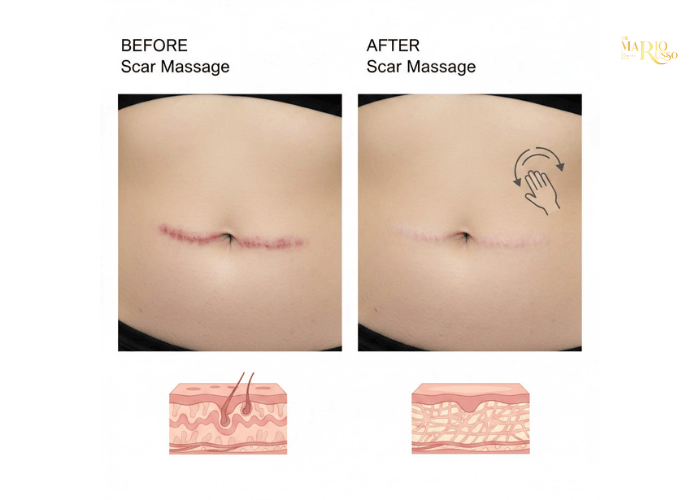
Scar massage is not a gentle rub with a fancy lotion; it is a therapeutic technique designed to break the cycle of hard, fibrous collagen formation. This is the gold standard for how to break up scar tissue after tummy tuck.
When to Start:
Crucially, you should never begin scar massage until your incisions are completely closed, dry, and cleared by your surgeon, usually around 2 to 4 weeks post-surgery. Starting too soon can cause wound breakdown. Always seek clearance!
Dr. Mario’s Core Massage Techniques
Aim for 5-10 minutes, two to three times per day. You should use enough pressure to blanch (whiten) the skin, and it should feel slightly uncomfortable, but not acutely painful. Persistence is key! This is how to effectively reduce scar tissue after tummy tuck.
- A. Technique 1: Cross-Friction Massage
- Action: Place the pads of two fingers (index and middle) directly on the scar tissue. Push firmly down and move your fingers in a small, tight, “sawing” or circular motion perpendicular (crosswise) to the line of the scar.
- Goal: You should be moving the scar tissue itself, not just sliding over the skin. Repeat this cross-friction movement over the entire length of the incision.
- B. Technique 2: Vertical and Horizontal Skin Stretching (Adhesion Prevention)
- Action: Place your fingers 1-2 inches above the scar. Gently push the skin down toward the scar line, but not over it. Hold for 5 seconds.
- Next: Now place fingers 1-2 inches below the scar. Gently push the skin up toward the scar line. Hold for 5 seconds.
- Finally: Repeat the stretching motion by pushing the skin side-to-side (horizontal) all along the incision line.
- C. Technique 3: The Pinch-and-Roll (Advanced)
- Action: Using your thumb and index finger, gently pinch a small section of the scar tissue and the surrounding skin to lift it into a small ridge.
Goal: Once lifted, gently roll the tissue between your fingers for 5-10 seconds. This action helps to lift the scar from the underlying fascia, preventing that tight, pulling sensation. Move along the entire length, pinching and rolling each section.
2. Silicone: The Scar Scientist’s Secret Weapon
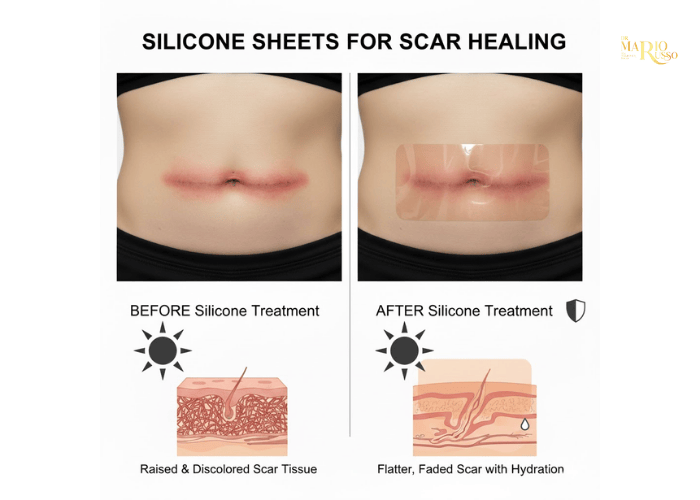
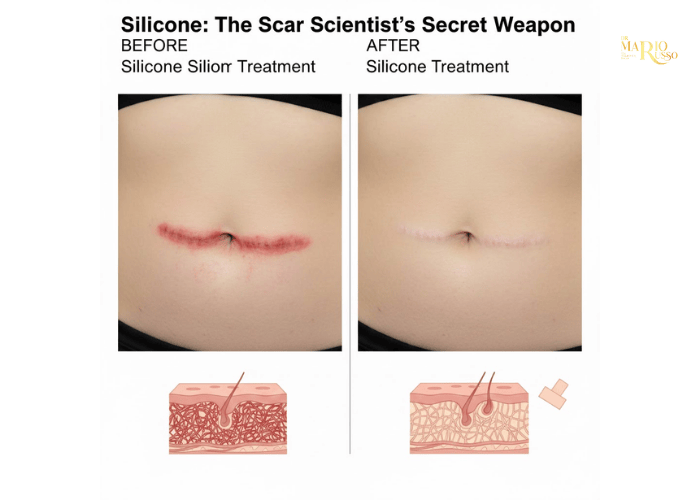
Silicone therapy, in the form of gel sheets or topical gels, is an absolute non-negotiable in the professional scar reduction world.
- How it Works: Silicone creates an ideal healing micro-environment by increasing hydration and regulating temperature at the scar site. This increased moisture tells the body’s fibroblasts to slow down the aggressive collagen production, allowing the scar to flatten, soften, and fade more quickly.
- Application: Silicone sheets must be worn for 12-24 hours a day for several months. They should be cut to cover the entire length of the scar. Gels are a great alternative for active individuals or for the belly button incision where a sheet can be impractical.
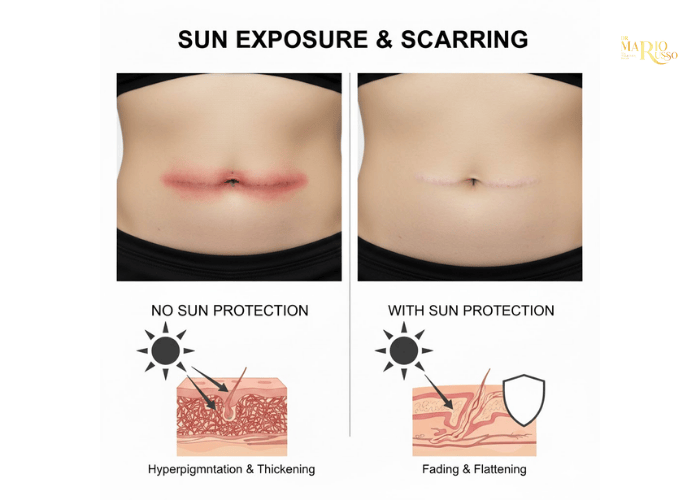
3. Protection from the Sun
If you take one piece of advice to heart, let it be this: Sunlight is the enemy of a fading scar. UV radiation causes newly formed scar tissue to hyperpigment, meaning it will turn a deep, permanent dark red or brown color that stands out sharply against your surrounding skin. This effect can last for years.
The rule is simple: Cover it up. For at least 12 to 18 months, if your scar sees daylight, it must have a high-SPF (30+) broad-spectrum sunscreen applied, or better yet, be fully covered by clothing.
The Long Game: What Happens After Massage?
Even with diligent massage and silicone use, some scars might develop challenging characteristics. This is often due to genetics (a predisposition for thick scarring, or hypertrophic scars) or high tension on the incision line. In these cases, Dr. Russo has advanced, minimally invasive options to fine-tune the result:
- Steroid Injections: For scars that become thick, raised, red, and itchy (hypertrophic scars), a series of corticosteroid injections can dramatically flatten and soften the tissue. These are administered directly into the scar tissue in-office.
- Laser Therapy: Non-ablative or fractional laser treatments can significantly improve both the colour (reducing redness) and the texture of a mature scar by stimulating healthy collagen re-modeling beneath the skin’s surface.
- Scar Revision: In rare cases where a scar has widened significantly or healed poorly (a tethered scar), a surgical scar revision procedure may be necessary. This is typically a minor procedure performed under local anaesthesia to excise the old scar and close the wound with more refined, layered suturing to minimize tension.
A Partnership in Healing
Your decision to undergo an abdominoplasty was a deeply personal step toward a more comfortable and confident life. Don’t let the anxiety over the healing scar tissue after tummy tuck dampen your joy. By partnering with an expert like Dr. Mario Russo and diligently following a consistent scar management plan, focusing on the precise massage techniques, silicone therapy, and sun avoidance, you are taking control of the final result.
Remember: the goal is not to eliminate the scar entirely, a surgical line will always exist, but to ensure it heals into the most refined, flat, and discreet mark possible, maximizing your tummy tuck before and after scar satisfaction.
5 Common Concerns About Tummy Tuck Scar Tissue (FAQ)
It’s natural to have lingering doubts and important questions before committing to this long-term healing process. Here are five of the most common concerns patients raise about their abdominoplasty scar and healing:
1. Why is my scar hard and lumpy? Is it supposed to be this firm?
Yes, it is very common and perfectly normal. The hardness and lumpiness you feel is exactly the excess collagen and fibrous internal scar tissue after tummy tuck we discussed. This firmness peaks between 3 and 6 months. This is your body’s initial, aggressive attempt to heal. If you feel lumps away from the main incision line, they may be residual swelling (edema) or fat necrosis, which your surgeon should monitor. The good news is this firmness is exactly what the regular scar massage is designed to break down.
2. The skin right above the scar feels numb, but the scar itself is itchy. Why?
This sensory contradiction is incredibly common. The numbness in the lower abdomen happens because the small sensory nerves in the area are temporarily disrupted when the skin is lifted during the tummy tuck. These nerves slowly regenerate, and sensation usually returns over 6 to 12 months. Conversely, the itching is a sign that the nerves are waking up and healing within the scar tissue itself. Keep the area hydrated and continue with silicone treatment to soothe the irritated skin.
3. How long does it really take for the scar to "fully fade?
Scar maturation is a long process that can feel agonizingly slow. While the initial redness and swelling subside within 6 weeks, the scar takes an average of 12 to 18 months to fully mature. This means going from a raised, red or pink line to a flat, soft, silvery-white line that blends discreetly into the skin. Patients often check their tummy tuck scar after 6 months and find it is still very red, but significant improvement is often seen by the time they view their tummy tuck scar after 1 year. Even then, it may continue to soften until you reach the final result of your tummy tuck scar after 3 years. Patience is paramount.
4. Can my scar be stretched out or widen if I start exercising too soon?
Absolutely. Tension is the primary enemy of a thin scar. Any strenuous activity, heavy lifting, or aggressive abdominal stretching within the first 6 to 8 weeks puts immense tension on the healing incision. This can cause the internal and external sutures to pull, leading to the formation of a widened scar that can be difficult to correct. Always wait until you receive explicit clearance from your surgeon, like Dr. Russo, before returning to intense core work.
5. My scar is red and thick. Could this be a keloid scar?
While terrifying to think about, true keloid scars (which grow aggressively beyond the original boundaries of the incision) are rare on the abdomen and are often genetic. What you are likely seeing is a hypertrophic scar. This is a raised, thick, red scar that stays within the confines of the incision line. Hypertrophic scars respond very well to the conservative treatments mentioned, silicone, massage, and especially targeted steroid injections. Your surgeon is the best person to distinguish between the two.
– This blog post is for informational purposes only and is not a substitute for professional medical advice, diagnosis, or treatment. |
– Individual results and healing times may vary. Do not start any scar management protocol, including massage, without explicit clearance from your plastic surgeon. |