
Repairing the Complex: Surgical Solutions for Inverted, Enlarged, or Painful Areola
Addressing Complex Areola Concerns with Clarity and Care!
Concerns about the areola can feel deeply personal, often affecting how comfortable you feel in your own body. Whether it’s an inverted areola, noticeable enlargement, or persistent pain that causes worry, these changes can impact both confidence and peace of mind.
Repairing the Complex focuses on understanding these concerns with sensitivity and clarity, while highlighting safe, effective surgical solutions designed to restore balance and comfort.
Repairing the Complex focuses on understanding these concerns with sensitivity and clarity, while highlighting safe, effective surgical solutions designed to restore balance and comfort.
Dr. Mario Russo offers these advanced procedures in areola surgery with a patient-first approach, combining precise surgical skill with genuine empathy to achieve natural-looking results while always prioritising your health, confidence, and emotional well-being.
Areola: What’s Normal and What’s Not?
The areola is the pigmented skin surrounding the nipple. Its size, colour, and shape vary naturally from person to person and can change over time.
A normal areola may:
- Change during puberty
- Darken during pregnancy
- Stretch with weight changes or breastfeeding
However, certain changes may feel distressing or uncomfortable and should not be ignored.
These include:
- Inverted areola (not involving the nipple)
- Enlarged areola in women or men
- Painful bumps or lumps on the areola
- Sudden or unexplained shape changes
When such concerns persist or appear suddenly, a professional medical evaluation is important.
Inverted Areola: More Than a Cosmetic Concern
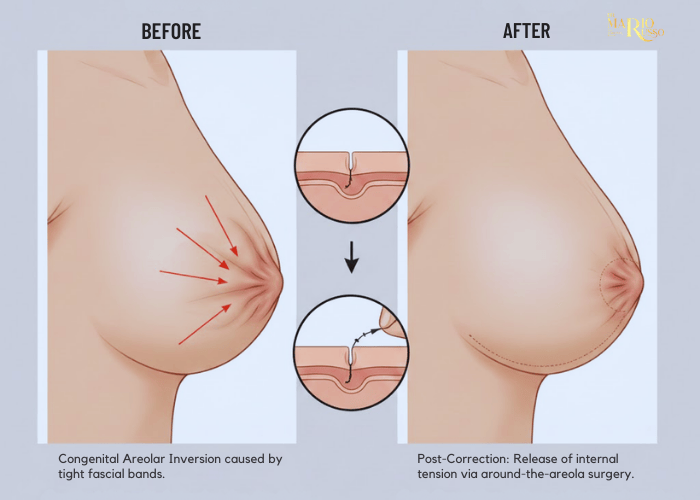
An inverted areola, where the surrounding pigmented skin appears pulled inward while the nipple itself remains normally positioned, can be present from birth or develop later in life.
Is an Inverted Areola Normal?
- Some individuals are born with an inverted areola
- Others may develop it due to structural or tissue changes over time
While many cases are benign, new or progressive inversion should always be medically assessed.
Inverted Nipples vs Pregnancy-Related Areola Changes
During pregnancy, hormonal changes can temporarily alter the appearance of the nipples and areolas. These changes are usually symmetrical and reversible after delivery or breastfeeding.
However, new inversion that occurs suddenly, especially on one side, should never be ignored and requires medical evaluation.
Inverted Areola and Underlying Breast Conditions
In rare cases, sudden inversion of the areola may be associated with underlying breast conditions, including malignancy. This does not mean that every inverted areola is dangerous, but it does highlight the importance of timely evaluation.
When surgical correction is appropriate, Dr. Mario Russo prioritises medical clarity first, ensuring any underlying concern is ruled out before addressing aesthetic correction.
Enlarged Areola: When Size Affects Confidence
An enlarged areola may develop gradually or appear more noticeable after physical or hormonal changes.
Common Causes of Enlarged Areola
- Genetics
- Pregnancy and breastfeeding
- Weight fluctuations
- Hormonal imbalance
- Previous breast surgery
Enlarged Areola in Women
Women may notice their areolas appear stretched, asymmetrical, or disproportionate to the breast size, often after pregnancy or weight changes.
Enlarged Areola in Men
Men can also experience enlarged areolas, commonly related to weight gain, hormonal changes, or gynecomastia. This can affect chest confidence and body image.
The good news is that areola reduction surgery offers a reliable and long-term solution for suitable candidates.
Areola Reduction Surgery: What Can You Expect?
Areola reduction surgery is designed to reduce the diameter of the areola while preserving sensation, pigmentation, and a natural appearance.
Areola Reduction Surgery: Before and After Results
Patients often report:
- Improved symmetry
- Better proportion with breast size
- A more youthful and balanced appearance
- Increased self-confidence
Scarring is minimal and typically blends along the natural border of the areola. Dr. Mario Russo focuses on subtle refinement rather than overcorrection, ensuring results remain natural.
Heart-Shaped Areola Surgery: Aesthetic Personalisation
Some patients seek a customised appearance rather than a traditional circular shape. Heart-shaped areola reduction surgery allows for aesthetic personalisation while maintaining anatomical safety.
This specialised technique is carefully planned to:
- Preserve blood supply
- Maintain natural pigmentation
- Prevent long-term distortion
Due to its complexity, this procedure should only be performed by an experienced surgeon such as Dr. Mario Russo, who prioritises both aesthetics and safety.
Painful Bumps and Lumps on the Areola: When to Be Concerned
Painful Pimple on the Areola
This may be caused by:- Blocked glands
- Ingrown hair
- Localised infection
Painful Lump on the Areola
A pea-sized lump on the areola that is painful to touch may indicate:- A cyst
- An abscess
- Inflammatory changes
- Rarely, more serious conditions
Dr. Mario Russo’s Approach for Areola Surgery: Safety, Sensitivity, and Support
Modern areola surgery is safe when performed by an experienced plastic and cosmetic surgeon.
Dr. Mario’s approach includes:
- Thorough consultation
- Honest discussion of expectations
- Conservative surgical planning
- Minimal scarring techniques
Whether addressing inversion, enlargement, or pain, each procedure is customised. No two areolas are the same. Also, no patient should feel rushed into a decision.
Areola Surgery in Women and Men: Key Differences
Large or stretched areolas
Pregnancy, hormones, weight changes
Better breast proportion
Shape, symmetry, softness
Sometimes needed
Breast lift or augmentation
Prominent or wide areolas
Weight gain, hormones, gynecomastia
More masculine chest look
Flat, clean contour
Rarely needed
Improved chest confidence
Who is a Good Candidate?
You may benefit from surgery if you:
Recovery and Results
Recovery is usually smooth and manageable. Most patients:
Final results continue to be refined over a few months.
Remember, the goal is not perfection.
The goal is Comfort, Confidence, and Peace of Mind.
Seek Precise and Professional Areola Surgery with the Expert in the Field - Dr. Mario Russo
Choosing areola surgery is not just about physical change; it is about feeling comfortable, confident, and reassured in your own skin.
With a deep understanding of both aesthetic detail and medical safety, Dr. Mario Russo offers precise, professional care tailored to your individual concerns.
He offers end-to-end support from the first consultation to the final results. His approach is guided by expertise, transparency, and compassion. When you place your trust in an expert who values accuracy as much as patient well-being, you take a confident step toward clarity, comfort, and renewed self-assurance.
If something doesn’t feel right, it deserves attention because you deserve clarity, comfort, and care!
FAQ'S
What does "extended tummy tuck" mean?
An enlarged areola means the darker skin around the nipple appears wider or stretched compared to what feels natural or proportionate for your chest.
Why is my areola enlarged?
Areolas can enlarge due to hormonal changes, pregnancy, breastfeeding, weight gain, or natural ageing of the skin.
What causes an enlarged areola?
Common causes include genetics, hormonal fluctuations, breast growth, weight changes, and previous breast-related procedures.
Why is my areola painful?
Pain may occur due to blocked glands, skin irritation, infection, cysts, or hormonal sensitivity. Persistent pain should be medically checked.
How much does areola reduction surgery cost?
The cost varies depending on the technique used, the complexity of the procedure, and whether it is combined with other treatments. A personalised consultation is required to provide an accurate estimate.
Legal & Medical Compliance
Important Disclaimer
This content is intended for educational purposes only and does not replace professional medical advice, diagnosis, or treatment. Any changes in the appearance or sensation of the breast, nipple, or areola should be evaluated by a qualified medical professional.